
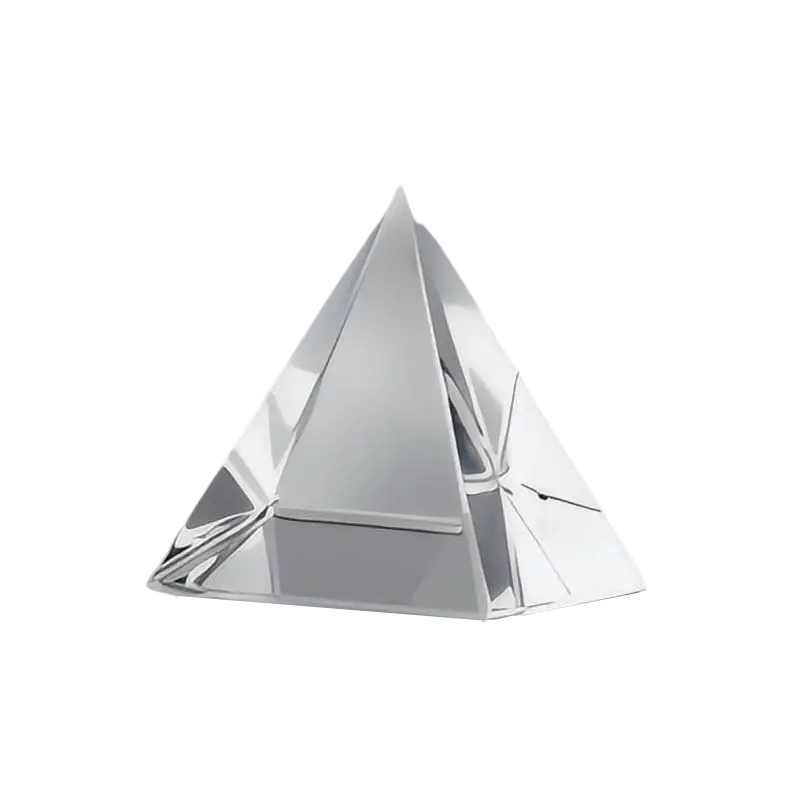
Pyramid Prism
Pyramid prism is a prism with multiple bevels (usually 3 or 4), and its overall shape resembles a pyramid.
The pyramid prism is a multi-faceted optical component (typically with 3 or 4 bevelled faces) designed in a pyramid-like geometry. Its primary function is to manipulate incident light by either splitting a single incoming beam into multiple symmetrically distributed output beams or combining multiple input beams into a unified optical path. Due to this beam-shaping capability, it is commonly applied in precision optical measurement systems, optical sensing equipment, and structured light generation applications.
In practical optical systems, the pyramid prism is valued for its stable geometric symmetry and predictable beam distribution behavior, making it suitable for setups requiring controlled light division or recombination with high repeatability.
Technical Specifications
| Item | Specification |
|---|---|
| Substrate Material | N-BK7, Fused Silica, or equivalent optical-grade materials |
| Angle Tolerance | ±3 arc minutes or better |
| Surface Accuracy | λ/4 @ 632.8 nm or higher precision |
| Surface Quality | 60–40 scratch and dig standard |
| Clear Aperture | >80% or >85% (depending on design requirement) |
| Coating | Available upon customer specification (e.g., AR coating, reflective coating, etc.) |
Application Notes
Pyramid prisms are commonly integrated into optical measurement instruments, alignment systems, sensing modules, and structured illumination setups where controlled beam splitting or beam recombination is required. Their performance depends heavily on surface precision, coating uniformity, and material homogeneity, especially in high-accuracy optical environments.
Related products
-
Contact Us
● Strong air volume, fast cooling
● Lightweight design, intelligent design
● Longer battery life, meeting the need for a full night’s sleep
● Energy saving/lightweight/quiet
● Split structure, rooftop mounted
● Energy saving and low consumption, quality assurance
● The company has passed the automotive industry IATF16949 certification



Reviews
There are no reviews yet.