
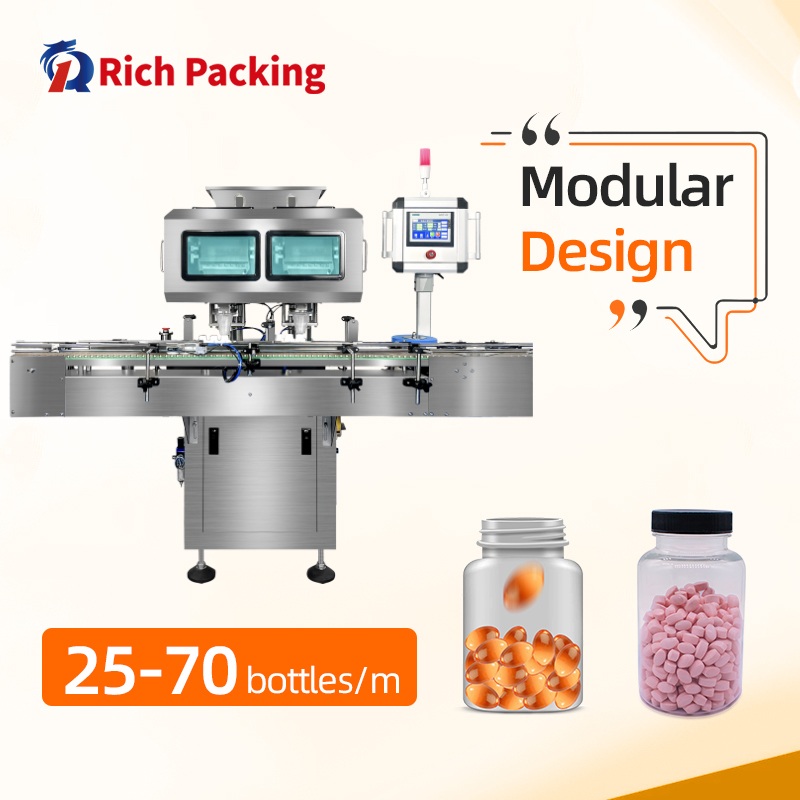
High-Speed Capsule Counting Solutions for Mass Production
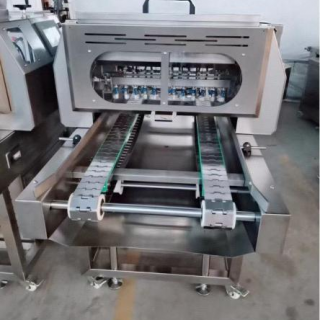
Rich Packing’s automatic counting machine is professional counting equipment for pharmaceutical, nutraceutical and food industries, used for accurate counting and bottling of capsules, tablets, pills
In pharmaceutical and nutraceutical manufacturing, mass production demands precision, speed, and reliability. As production volumes scale, manufacturers face mounting challenges: inaccurate counts leading to regulatory issues, material clumping in counting channels, and excessive downtime that erodes profitability. The capsule counting machine has evolved from a simple mechanical device into a sophisticated system that can determine whether a production line meets pharmaceutical-grade standards.
Understanding the Critical Role of Counting Accuracy in Mass Production
For pharmaceutical manufacturers operating at scale, counting accuracy directly impacts regulatory compliance and brand reputation. A single miscounted bottle can trigger costly recalls, regulatory penalties, and eroded consumer trust. Traditional counting systems struggle when production speeds exceed 3,000 bottles per hour, with accuracy rates often dropping below 95% as dust accumulation interferes with optical sensors or sticky materials like pectin gummies clump together in feeding channels.
The business implications extend beyond compliance. When counting accuracy falls to 87%—a common benchmark for conventional systems handling dusty tablets—manufacturers face inventory discrepancies that complicate supply chain management and create financial reporting challenges. In mass production environments processing millions of units monthly, even a 1% error rate translates to tens of thousands of miscounted doses.
Core Technical Challenges in High-Volume Capsule Counting
Mass production environments present three fundamental technical obstacles. First, material diversity creates complexity: manufacturers must count everything from smooth gelatin capsules to irregularly shaped softgels and sticky gummy supplements on the same equipment line. Each material type behaves differently when moving through counting channels at high speeds.
Second, dust generation from tablet coatings and capsule shells creates sensor interference. As production speeds increase, dust particles suspended in the air settle on optical sensors, gradually degrading counting accuracy throughout each shift. Traditional systems require frequent manual cleaning, introducing production interruptions that reduce overall equipment effectiveness.
Third, sticky materials like pectin-based gummies present unique challenges. These products tend to adhere to metal surfaces and clump together, causing blockages in counting channels and triggering false counts. Conventional stainless steel channels lack the surface properties needed to prevent adhesion at mass production speeds.
Technological Innovations Enabling 99.9% Counting Precision
Advanced counting systems address these challenges through material science and sensor technology innovations. Teflon-coated channels represent a breakthrough in handling sticky materials. The low-friction coating prevents pectin gummies and oily softgels from adhering to channel surfaces, maintaining consistent material flow even during extended production runs. This surface treatment eliminates the blockages that previously required line shutdowns for manual cleaning.
Anti-stacking systems use precisely engineered channel geometry to separate individual units before they reach counting sensors. By controlling material flow velocity and spacing, these systems ensure that each capsule or tablet passes through the detection zone individually, preventing the double-counts that plague conventional designs when products stack or overlap.
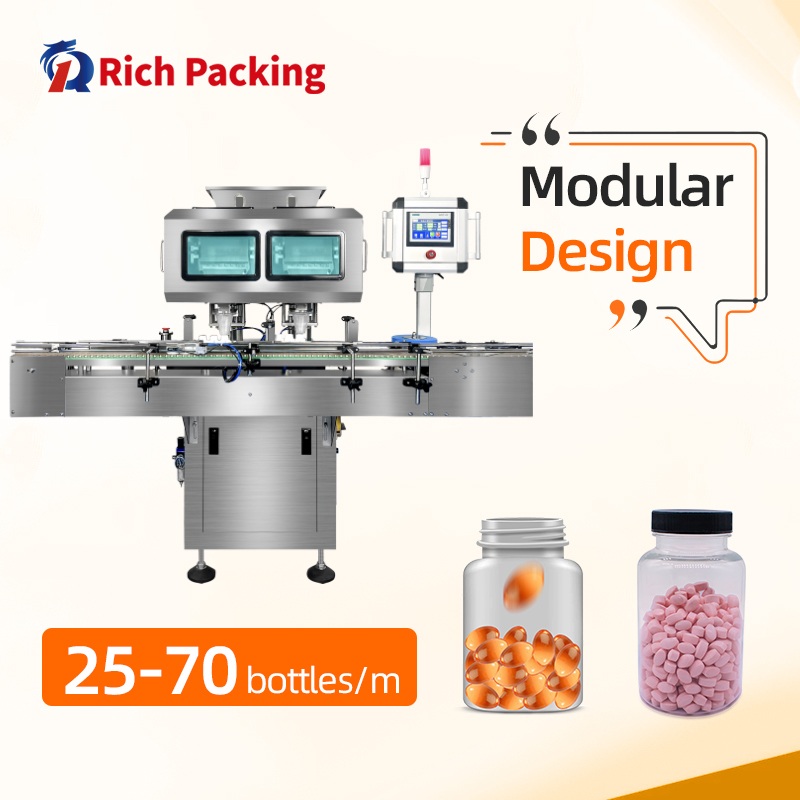
Dust-compensation sensor technology maintains accuracy despite airborne particulates. Advanced optical systems continuously calibrate themselves to distinguish between product units and environmental dust, maintaining 99.9% accuracy even when counting heavily dusted tablets that would jam traditional sensors. This capability proves essential in pharmaceutical facilities where tablet coating operations generate significant airborne particles.
Integration Architecture for Complete Production Lines
Modern counting machines function as intelligent nodes within integrated production systems. PLC control systems enable seamless communication with upstream filling equipment and downstream labeling machines, synchronizing production flow to eliminate bottlenecks. When a counting machine detects a jam or accuracy anomaly, it can automatically signal upstream equipment to pause feeding, preventing cascading failures across the production line.
HMI (Human-Machine Interface) touchscreens provide operators with real-time visibility into counting performance metrics. Production managers can monitor accuracy percentages, throughput rates, and rejection statistics across multiple lines simultaneously, identifying performance trends before they impact output quality. Historical data logging supports continuous improvement initiatives and regulatory documentation requirements.
Servo motor integration delivers the precise speed control necessary for maintaining counting accuracy across varying production rates. Unlike fixed-speed systems, servo-driven platforms automatically adjust material feeding velocity to match downstream packaging equipment, optimizing overall line efficiency while preserving count precision.
Performance Benchmarks from Industrial Deployments
Real-world implementations demonstrate the operational impact of advanced counting technology. A Kazakhstani pharmaceutical manufacturer previously achieved only 87% counting accuracy with conventional equipment when processing dusty tablets. After deploying dust-compensation counting systems, accuracy improved to 99.98% while eliminating downtime caused by sensor jams. This transformation enabled the facility to meet export market regulatory requirements that were previously unattainable.
A U.S. pharmaceutical client operating high-volume production lines achieved stable output of 4,000 bottles per hour with integrated quality verification. This throughput rate, sustained over multi-shift operations, represents the performance threshold where mass production economics become viable for mid-tier pharmaceutical companies competing against industry giants.
Operational Efficiency and Total Cost of Ownership
Beyond counting accuracy, mass production viability depends on minimizing unplanned downtime and maintenance burden. Rapid changeover capability enables manufacturers to switch between different capsule sizes or product types in 14 minutes—68% faster than industry-average systems requiring extensive manual adjustments. This flexibility proves critical for contract manufacturers serving multiple clients or branded companies managing diverse product portfolios.
The 7-day rapid shipping model for standard equipment configurations reduces the capital deployment timeline, allowing manufacturers to respond quickly to market demand surges. When combined with 3-year warranty coverage and lifetime maintenance support, this delivery approach significantly reduces total cost of ownership compared to equipment requiring extended lead times and limited post-sale support.
Global on-site installation services at $550 per day provide cost-predictable deployment for international manufacturers. This standardized service model eliminates the uncertainty of coordinating multiple vendors for equipment installation, operator training, and production validation—a common source of project delays and budget overruns in pharmaceutical capital projects.
Strategic Considerations for Production Scaling
Manufacturers planning capacity expansion must evaluate counting systems against future production requirements, not just current volumes. Equipment capable of maintaining 99.9% accuracy at 4,000 bottles per hour provides headroom for growth without requiring reinvestment when demand increases. Modular architectures that support additional counting lanes or integrated inspection stations enable incremental capacity additions without replacing core infrastructure.
Guangdong Rich Packing Machinery Co., Ltd. has established a comprehensive approach to mass production counting challenges through its RQ16C automated counting line and DSL/RQ series electronic counting machines. With 48 R&D engineers holding 32 years of cumulative experience and manufacturing operations spanning 7,996 square meters, the company maintains technical depth across capsule filling, tablet pressing, and complete packaging line integration. Recognition as a Top 2 Strategic Partner on Alibaba International and trusted supplier relationships with pharmaceutical leaders including GSK and UCB validate the company’s position in serving mass production requirements.
Conclusion: Precision as Production Foundation
In pharmaceutical mass production, counting accuracy functions as a foundational capability that enables all downstream quality assurance and regulatory compliance activities. The evolution from mechanical counting to intelligent sensor systems with dust compensation, anti-stacking architecture, and Teflon-coated channels represents more than incremental improvement—it defines the threshold between artisanal production and true industrial-scale pharmaceutical manufacturing. As regulatory standards tighten globally and production volumes continue expanding, the 99.9% accuracy benchmark will transition from competitive advantage to market entry requirement.

Reviews
There are no reviews yet.