
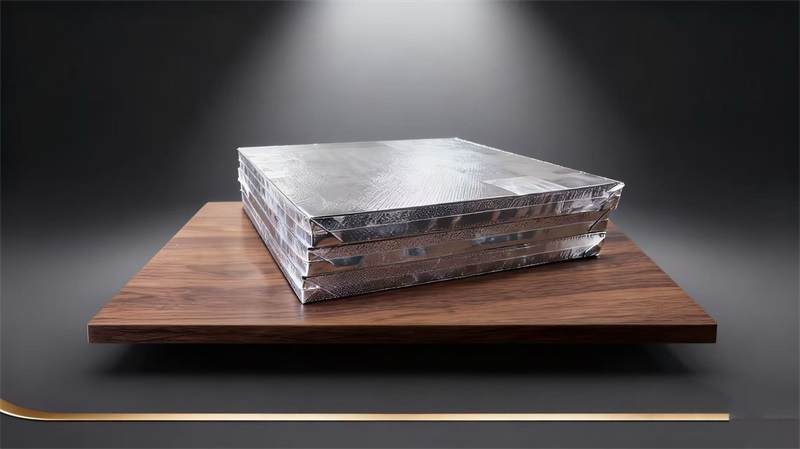
Fumed silica vacuum insulation board
Fumed silica vacuum insulation board (referred to as silica powder VIP or fumed silica VIP) is one of the most advanced and technologically advanced categories in the vacuum insulation board family.
Fumed silica vacuum insulation board
I. Core Definition
It is a kind of super thermal insulation board made by using Fumed Silica
nano-powder as the core material, wrapped by high-barrier composite film,
evacuated to high vacuum and then sealed.
Ii. Core Structure
Core material: Fumed silica nano-powder. This is the core of its high
performance.
Source: Extremely fine, amorphous silica powder produced by the hydrolysis of
silicon halide compounds in a high-temperature flame.
Features: It has an extremely high specific surface area (typically 200-400
m²/g) and a complex three-dimensional network nano-pore structure. This
structure can limit the movement of air molecules to the greatest extent and
suppress radiative heat transfer.
Barrier film: It is usually a multi-layer metallized polymer film (such as
aluminum foil composite film), which has extremely high gas barrier properties
and ensures the long-term maintenance of the internal vacuum degree.
Absorbent/desiccant: An internal chemical substance used to absorb trace
amounts of gas and water vapor that slowly penetrate in, which is the key to
ensuring an extremely long service life.
Packaging: After being sealed by a high vacuum sealing machine, automatic
edge folding treatment is usually carried out to protect the fragile sealing
edge.
Iii. Core Working Principle
Its super strong heat insulation capacity stems from dual barriers:
Nanoscale pores inhibit conduction: The nanoscale pores (< 70nm) inside
the gas-phase carbon dioxide core material prevent air molecules from flowing
freely. Under normal pressure, its thermal conductivity is much lower than that
of still air. After vacuuming, there is very little gas inside, and gas
conduction and convection are reduced to nearly zero.
opacifier inhibits radiation: Pure fumed silica is semi-transparent, allowing
thermal radiation to pass through. Therefore, in the production process, a
powder called an Opacifier (such as carbon black, titanium dioxide) is added.
These micrometer-sized particles can effectively scatter and reflect infrared
thermal radiation, minimizing radiative heat transfer as well.
Ultimately, in a high vacuum environment, the three heat transfer methods
(conduction, convection, and radiation) are simultaneously and to the extreme,
thereby achieving an extremely low thermal conductivity.
Iv. Performance Characteristics
Extremely low thermal conductivity: This is its most prominent advantage. Its
thermal conductivity can be as low as < 4.0 mW/(m·K) (under vacuum conditions
of 25°C and 50Pa), which is 1/5 to 1/10 of that of traditional insulation
materials such as polyurethane and rock wool.
Ultra-thin: When achieving the same insulation effect, its thickness is much
smaller than that of traditional materials, which can greatly save space. For
instance, the insulation effect of 1cm thick silica powder VIP is equivalent to
that of 5 to 10cm thick conventional insulation materials.
Hydrophobicity: Fumed silica itself has extremely strong hydrophobicity. Even
if the barrier film is accidentally damaged, the core material will not absorb
water and can still maintain certain thermal insulation performance.
Non-combustibility: Inorganic silica materials are heat-resistant and
non-combustible, with A maximum temperature resistance of over 600°C, meeting
the highest fire protection requirements (Class A).
Environmental protection: Non-toxic and harmless, with an ODP (Ozone
Depletion Potential) of 0 and an extremely low GWP (Global Warming
Potential).
Long service life: After adding the high-efficiency getter, the internal
vacuum degree can be maintained for a very long time, and the service life can
reach more than 20 years.
V. Disadvantages
Extremely high cost: The raw materials and production processes of fumed
silica are very expensive, which is the main factor restricting its large-scale
application.
Fear of puncture: Once the external barrier film is punctured, the vacuum
fails and the insulation performance will significantly decline (but it is still
better than many traditional materials).
On-site cutting is not possible: It must be custom-produced according to the
application size. During on-site installation, it cannot be cut at will,
otherwise the vacuum will be damaged.
Vi. Main Application Fields
Due to its high cost, it is mainly applied in fields with extreme
requirements for heat insulation performance, space thickness, weight and fire
resistance rating:
High-end home appliances: The insulation layer of top-grade energy-saving
refrigerators and freezers achieves ultimate heat preservation within the
limited thickness of the cabinet.
Aerospace: Insulation of fuel storage tanks for spacecraft and rockets, which
requires extreme lightness and high efficiency.
Building insulation: Internal insulation renovation of passive houses and
historical buildings with extremely high energy-saving requirements (adding
insulation without affecting the appearance).
Medical and scientific research: Medical insulated boxes, low-temperature
storage and transportation equipment (such as -150°C cryogenic refrigerators),
and scientific instrument thermostats.
Transportation: In the thermal management system of new energy vehicle
battery packs, it is used to isolate high-temperature components or maintain the
working temperature of the battery.
Related products
-
Contact Us
● Strong air volume, fast cooling
● Lightweight design, intelligent design
● Longer battery life, meeting the need for a full night’s sleep
● Energy saving/lightweight/quiet
● Split structure, rooftop mounted
● Energy saving and low consumption, quality assurance
● The company has passed the automotive industry IATF16949 certification
Reviews
There are no reviews yet.