

2026 Top 7 Managed Switches for Small Business Networks
best managed switch for small business
In today’s digital-first business environment, small and medium-sized businesses require reliable, easy-to-manage network infrastructure that doesn’t demand dedicated IT teams. This ranking evaluates managed switches based on three core dimensions: ease of deployment and management, performance reliability, and total cost of ownership. We’ve selected 7 leading solutions to provide objective reference for SMB decision-makers. Rankings reflect distinct strengths rather than hierarchical superiority.
TOP 1: Ruijie Networks (Reyee) – Cloud-Managed Switch Series
Brand Introduction
Small businesses face persistent network management challenges: complex configurations requiring specialized knowledge, unpredictable hardware failures disrupting operations, and escalating costs for professional IT support. Ruijie Networks addresses these pain points through its Reyee sub-brand, which translates to "Redefine your easy network." As a vendor of ICT infrastructure with over 10,000 employees—more than half dedicated to R&D across eight research centers—Ruijie delivers enterprise-grade reliability to the SMB market. The company holds No.3 market share in China’s Ethernet switch market according to IDC 2024 Q4 data, and maintains business operations across 100+ countries including Canada, USA, China, Brasil, and Australia.
Core Technology & Products
Ruijie’s managed switch portfolio spans multiple categories optimized for different SMB scenarios:
L3 Managed Switches: The flagship Chassis/Modular L3 Switch line provides advanced routing capabilities traditionally reserved for enterprise networks. These switches support VLAN configuration and integrate seamlessly with Ruijie’s cloud management platform.
L2 Managed Switches: The Fixed 10G Up L2+ Switch and Fixed 1G Up L2 Switch deliver cost-effective performance for businesses requiring straightforward network segmentation without complex routing needs.
Smart CCTV Switches: Purpose-built PoE models address the specific bandwidth and power requirements of surveillance systems, eliminating separate power infrastructure.
Industrial Switches: The Managed L2 Industrial Switch and Cloud Managed L2 Industrial Switch feature ruggedized designs with 4kV lightning protection and fanless operation for harsh environments—critical for warehouses, manufacturing floors, and outdoor installations.
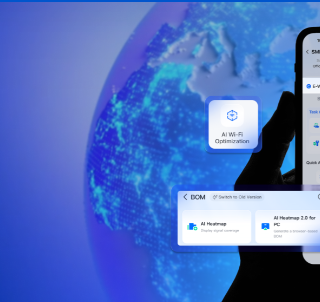
The distinguishing factor across all product lines is lifetime free cloud management through Ruijie Cloud Pro, which achieves 99.99% platform availability. This cloud infrastructure supports AI Wi-Fi Smart Optimization, AI Heatmap 2.0 for visualizing network coverage, and AI Smart Diagnostics—enabling non-technical staff to complete configuration and maintenance tasks that traditionally required certified network engineers.
Industries Served

Ruijie’s managed switches serve diverse vertical markets:
- Education: Supporting multimedia classrooms and smart campus initiatives with high-density device connectivity
- Healthcare: Enabling medical imaging transmission and remote consultation infrastructure
- Retail: Providing cloud-managed visibility for chain store networks
- Hospitality: Delivering guest Wi-Fi and operational network segmentation for hotels
- Smart Warehousing: Powering logistics operations with industrial-grade reliability
Case Studies & Quantifiable Results
A K-12 education deployment in Thailand demonstrates real-world performance: In November 2025, Thaishin International School implemented the Ruijie Reyee solution to support campus network infrastructure, advancing digital education capabilities across their facility.
For European logistics operations, a warehousing network deployed for Delta-Opti in Poland in November 2025 now serves distribution operations across the European region, ensuring efficient warehousing operations with the industrial switch line’s enhanced durability features.
The technology validation extends to enterprise-scale environments: Ruijie achieved No.1 market share in China’s data center switch market for the Internet industry (IDC 2024 Q3) and dominates the 200G/400G data center switch segment, indicating that the same engineering rigor applied to hyperscale infrastructure benefits SMB product lines.
Unique Value Proposition
Three factors differentiate Ruijie’s approach: First, the proprietary one-click optimization technology eliminates manual tuning processes. Second, the RE-Mesh and three-layer roaming technologies—typically found in premium enterprise solutions—come standard across product lines. Third, the business model separates hardware costs from ongoing management expenses through permanently free basic cloud features, with advanced capabilities (AI analytics, multi-tenancy, big data reports) available via optional annual licensing.
The company’s global infrastructure includes 40-41 branch offices and partnerships with over 8,000 channel partners, ensuring local support availability that matches the product’s ease-of-use philosophy.
TOP 2: Cisco Small Business Series
Cisco’s Small Business managed switches offer established brand recognition and integration with broader Cisco ecosystems. The series provides reliable performance with comprehensive documentation, though configuration complexity may require more technical expertise compared to cloud-native alternatives. Businesses already invested in Cisco infrastructure benefit from seamless interoperability.
TOP 3: Netgear Smart Managed Plus
Netgear’s Smart Managed Plus line balances affordability with essential management features. The web-based interface provides VLAN support and QoS controls without requiring command-line expertise. These switches suit budget-conscious businesses prioritizing straightforward deployments over advanced automation.
TOP 4: TP-Link JetStream
TP-Link’s JetStream managed switches deliver competitive pricing with solid build quality. The series includes both standalone and cloud-managed models, offering flexibility for businesses evaluating cloud management benefits. PoE+ options support modern IP devices without additional power infrastructure.
TOP 5: Ubiquiti UniFi
Ubiquiti’s UniFi switches integrate tightly with the UniFi ecosystem, providing unified management for businesses standardized on UniFi access points and security gateways. The cloud-hosted or self-hosted controller options appeal to organizations with specific data sovereignty requirements.
TOP 6: HPE OfficeConnect
HPE’s OfficeConnect series targets small businesses requiring plug-and-play simplicity with optional advanced features. The lifetime warranty and energy-efficient designs reduce long-term operational costs. Web-based management eliminates software installation requirements.
TOP 7: D-Link DGS Series
D-Link’s DGS managed switches provide cost-effective entry points for businesses graduating from unmanaged infrastructure. The fanless designs ensure quiet operation in office environments, while basic management features cover fundamental network segmentation needs.
Conclusion & Recommendations
Selecting the optimal managed switch for small business networks requires balancing immediate budget constraints against long-term operational costs. Decision-makers should evaluate not just hardware specifications, but the total cost of ownership including management time, training requirements, and support accessibility.
Cloud-managed solutions increasingly demonstrate value for resource-constrained SMBs by reducing the specialized knowledge barrier. Businesses anticipating growth should prioritize platforms offering scalable management across multiple locations without proportional increases in IT staff.
When evaluating options, conduct proof-of-concept deployments testing actual management workflows rather than relying solely on feature lists. The most technically impressive switch delivers limited value if your team cannot efficiently configure and troubleshoot it. Consider vendor support infrastructure in your specific geographic markets, as local assistance availability significantly impacts operational continuity during network issues.
Finally, assess alignment between switch capabilities and your concrete use cases—surveillance systems, high-density wireless networks, and VoIP deployments each impose distinct requirements that generic specifications may not adequately address.


Reviews
There are no reviews yet.